Howlite Stone: Meaning, Properties, Benefits, Uses, Care, and Buying Guide
Introduction
Howlite stone is a beautiful and distinctive mineral known for its soft white color, gray or black web-like veining, and calm natural appearance. Although it is not one of the traditional precious gemstones, Howlite has become popular among jewelry lovers, crystal collectors, interior decorators, and people interested in natural stones. Its marble-like appearance makes it especially attractive for beads, bracelets, necklaces, carvings, decorative objects, and polished stones.
The natural appearance of Howlite is usually white or creamy white with irregular gray, brownish-gray, or black veins. These patterns make every piece look slightly different. Some Howlite stones are also dyed to resemble other gemstones, particularly turquoise. Because Howlite is relatively porous and easy to color, it is commonly used as an alternative material for creating colorful gemstone-style jewelry.
In addition to its visual appeal, Howlite has an interesting geological history. It is a calcium boron silicate hydroxide mineral that commonly forms in evaporite deposits. The stone was named after Henry How, a Canadian chemist and geologist who identified the mineral in the nineteenth century.
This complete guide explores Howlite stone meaning, history, geological properties, appearance, hardness, uses, jewelry applications, care instructions, value, authenticity, dyed Howlite, and frequently asked questions.
What Is Howlite Stone?
Howlite is a naturally occurring mineral belonging to the borate mineral group. Its chemical formula is generally written as Ca2B5SiO9(OH)5. The mineral commonly develops in irregular nodules that can resemble cauliflower-shaped masses when found in its natural geological environment.
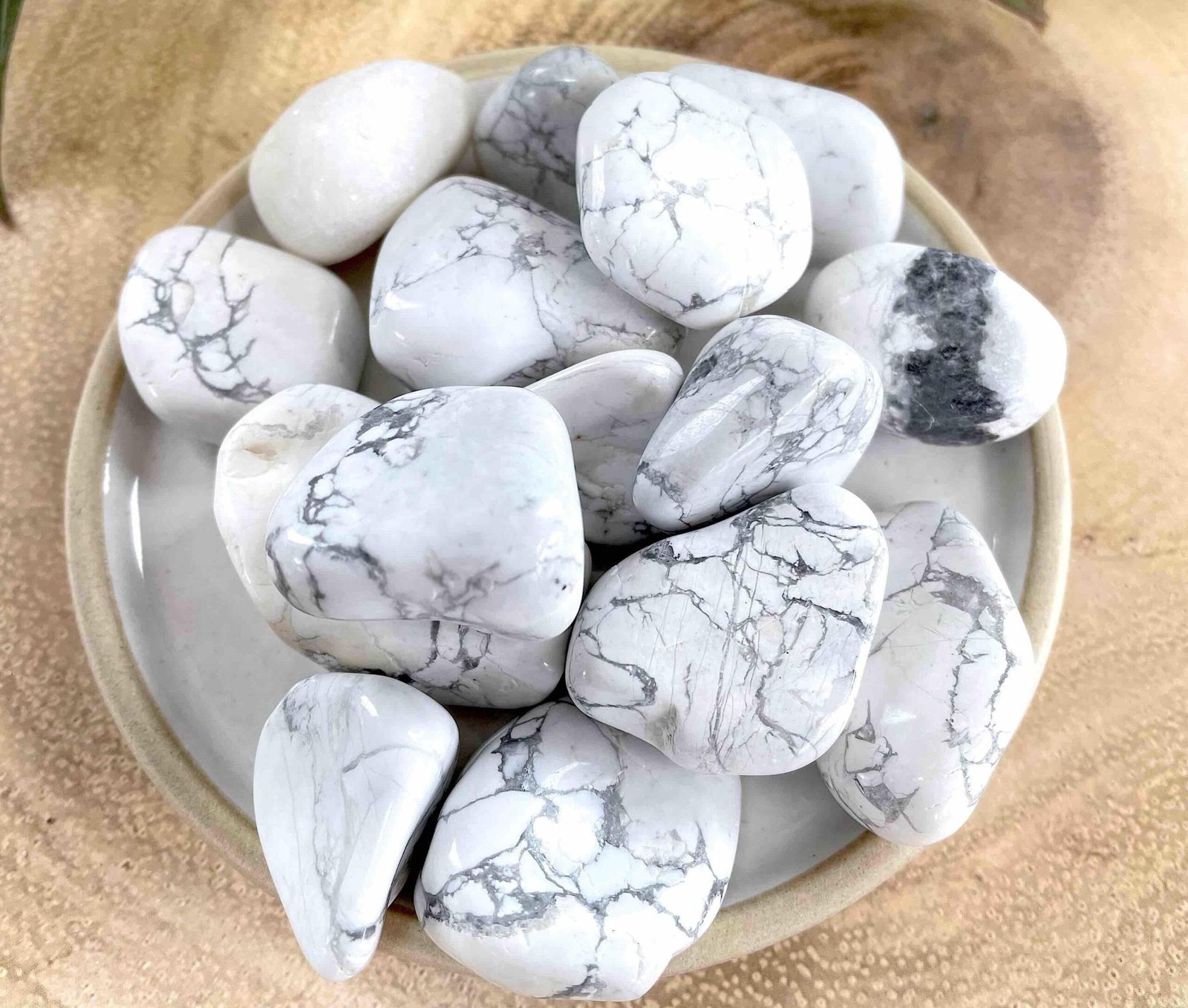
The most recognizable feature of Howlite is its white or ivory-colored body combined with thin, irregular gray or dark veins. These veins create patterns that can look similar to marble or spiderwebs.
Natural Howlite is usually opaque rather than transparent. When polished, it can develop a smooth surface with a soft, attractive luster.
Howlite is not considered a traditional precious gemstone like diamond, ruby, sapphire, or emerald. Instead, it is generally classified as an ornamental or semi-precious stone. Nevertheless, its unique appearance and versatility have made it an important material in the jewelry and decorative-stone market.
Howlite Stone Meaning
The meaning associated with Howlite often centers around calmness, patience, and reflection. In crystal and spiritual traditions, Howlite is frequently described as a stone connected with peaceful energy and emotional balance.
It is sometimes associated with:
- Calmness
- Patience
- Relaxation
- Self-reflection
- Mindfulness
- Emotional balance
- Peaceful thinking
- Personal awareness
These meanings come from traditional crystal practices rather than established scientific evidence. There is no scientific proof that Howlite has supernatural or healing powers.
Nevertheless, many people enjoy Howlite as a symbolic reminder to slow down, remain patient, and create peaceful moments in everyday life.
Howlite Stone History
Howlite was identified during the nineteenth century by Henry How, a Canadian chemist, geologist, and naturalist. The mineral was subsequently named after him.
Historical accounts connect the discovery of Howlite with Nova Scotia, Canada. The mineral became recognized as a distinctive borate mineral because of its unusual chemical composition and characteristic appearance.
Over time, Howlite became increasingly popular for ornamental purposes. Its pale color, attractive veining, relatively soft nature, and ability to absorb dyes made it particularly useful for jewelry production.
Today, Howlite can be found in gemstone shops, mineral collections, jewelry stores, craft markets, and online marketplaces around the world.
How Does Howlite Form?
Howlite forms primarily in evaporite environments. These are geological settings where mineral-rich water evaporates and leaves behind concentrated deposits of minerals.
The formation of Howlite is associated with boron-rich environments. Under suitable geological conditions, calcium, boron, silicon, oxygen, hydrogen, and other elements combine to form the mineral.
Howlite often develops as irregular nodules. In its natural environment, these nodules may have a rough and uneven exterior. Once removed from the ground, they can be cut, shaped, polished, or used in their natural form.
Its unusual formation process contributes to the distinctive patterns seen in polished specimens.
Where Is Howlite Found?
Howlite was first recognized in Canada, but deposits and specimens have also been reported from other regions.
Important sources associated with Howlite include:
- Canada
- United States
- Other areas containing borate-rich geological environments
Canada has historical significance because the mineral was first identified there.
When purchasing Howlite, the country of origin may sometimes be listed by the seller. However, origin alone does not necessarily determine the quality of a Howlite specimen.
What Does Howlite Look Like?
Natural Howlite is usually white, off-white, or creamy white. One of its most recognizable characteristics is its network of gray or dark veins.
The veins can be:
- Thin
- Thick
- Straight
- Curved
- Branching
- Spiderweb-like
- Irregular
No two pieces necessarily have exactly the same pattern. This natural variation is one reason collectors and jewelry designers appreciate Howlite.
When polished, the white background can become brighter and smoother, allowing the dark veining to stand out more clearly.
Howlite Stone Colors
The natural color of Howlite is generally light. Common natural appearances include:
- White
- Cream
- Ivory
- Pale gray
Dyed Howlite can appear in many other colors. Blue and turquoise-like colors are particularly common.
Other dyed colors may include:
- Blue
- Green
- Purple
- Pink
- Red
- Yellow
- Black
Dyed Howlite should be identified honestly as dyed material rather than being marketed as naturally occurring colored Howlite.
Why Is Howlite Dyed?
Howlite is relatively porous, which allows it to absorb dyes. Because its natural color is light, it provides an excellent base for coloring.
One of the most common uses of dyed Howlite is to imitate turquoise. Blue-green dyed Howlite with dark veining can resemble certain forms of turquoise at a much lower price.
This does not mean dyed Howlite is necessarily a poor material. It can still be attractive and useful for jewelry. The important issue is accurate labeling.
When buying a stone, customers should know whether they are purchasing:
- Natural Howlite
- Dyed Howlite
- Another gemstone
- A synthetic or imitation material
Howlite and Turquoise
Howlite and turquoise are sometimes confused because Howlite can be dyed blue or green to resemble turquoise.
However, they are different minerals.
Howlite is a borate mineral, while turquoise is a hydrated phosphate mineral containing copper and aluminum. Their chemical compositions and geological properties are therefore different.
Natural Howlite is normally white or creamy, while turquoise commonly appears blue, blue-green, or green.
Dyed Howlite can imitate turquoise visually, but it should not be sold as genuine natural turquoise.
Howlite Stone Hardness
Howlite has a Mohs hardness of approximately 3.5. This makes it considerably softer than many popular jewelry gemstones.
For comparison:
- Diamond: 10
- Sapphire: 9
- Quartz: 7
- Turquoise: around 5 to 6
- Howlite: around 3.5
Because Howlite is relatively soft, it can scratch more easily than harder gemstones.
This is an important consideration when using Howlite in rings, bracelets, necklaces, or other jewelry.
Howlite Stone Luster
Howlite generally has a vitreous to dull appearance depending on the specimen and its surface condition. Polishing can give the stone a smoother and more attractive appearance.
The contrast between its pale body color and darker veins is usually more visually important than its luster.
Howlite Stone Transparency
Howlite is generally opaque. Light does not normally pass through it in the way it can pass through transparent or translucent gemstones.
Its opaque appearance gives it a solid, marble-like character.
Howlite Stone Uses
Howlite has many practical and decorative uses.
Common applications include:
1. Jewelry
Howlite is frequently used for:
- Bracelets
- Necklaces
- Earrings
- Pendants
- Beaded jewelry
- Rings
- Charms
Its light color makes it easy to combine with metals and other stones.
2. Beads
Howlite beads are particularly popular. They can be produced in many shapes, including:
- Round beads
- Oval beads
- Barrel beads
- Flat beads
- Faceted beads
- Chip beads
3. Carvings
Because Howlite is relatively soft, it can be carved into decorative shapes.
Common examples include:
- Animals
- Hearts
- Spheres
- Figurines
- Decorative objects
- Small sculptures
4. Home Decoration
Large or polished Howlite specimens can be used as decorative stones in homes and offices.
5. Crystal Collections
Mineral collectors may appreciate natural Howlite specimens because of their distinctive mineral structure and historical importance.
Howlite Jewelry
Howlite jewelry has a clean and natural appearance. White Howlite can create a simple, elegant style without being visually overwhelming.
Howlite beads are especially popular because the dark veins provide natural contrast.
A Howlite bracelet can be paired with:
- Silver-colored metals
- Stainless steel
- Gold-colored metals
- Leather
- Other natural stones
The neutral color of Howlite makes it versatile for many designs.
Howlite Bracelet
Howlite bracelets are among the most common forms of Howlite jewelry.
A bracelet may contain polished round beads, smooth oval beads, or irregular natural pieces.
The white color can create a minimal appearance, while the gray veining adds visual character.
Because Howlite is not extremely hard, bracelets should be protected from strong impacts and scratches.
Howlite Necklace
Howlite necklaces can feature individual polished stones or multiple beads.
White Howlite works well with both casual and formal styles. It can also be combined with other stones to create layered jewelry designs.
Designers sometimes pair Howlite with darker stones to create contrast.
Howlite Earrings
Howlite earrings can be lightweight and visually attractive, especially when small polished beads or carved pieces are used.
White Howlite can complement many clothing colors because it has a neutral appearance.
Howlite Ring
Howlite rings can be beautiful, but extra care is recommended because rings are exposed to frequent impacts and contact with hard surfaces.
Since Howlite has a relatively low hardness, it can scratch more easily than harder gemstones.
For everyday wear, a protective setting can help reduce direct exposure of the stone.
Howlite Stone Benefits: Traditional Beliefs
Howlite is often associated with various benefits in crystal traditions.
Commonly claimed symbolic benefits include:
Calm and Relaxation
Howlite is traditionally associated with peacefulness and relaxation.
Patience
Some crystal enthusiasts use Howlite as a symbolic reminder to practice patience.
Reflection
Its white appearance is sometimes associated with clarity and quiet reflection.
Mindfulness
Howlite is frequently included in collections used for meditation or mindfulness practices.
It is important to distinguish these traditional beliefs from scientific evidence. These claims have not been established as medical treatments.
Howlite for Meditation
Some people choose Howlite as a meditation stone because of its appearance and traditional associations with calmness.
A person may simply hold a polished Howlite stone while focusing on breathing or quiet reflection.
The stone itself has not been scientifically proven to produce special mental or physical effects. Its usefulness in this context can be understood as a personal symbol or mindfulness object.
Howlite and Emotional Balance
In crystal traditions, Howlite is sometimes described as an emotional-balancing stone.
People may associate it with:
- Patience
- Calm thinking
- Self-awareness
- Peace
- Reflection
These are symbolic interpretations rather than scientifically demonstrated properties.
Howlite and Sleep
Howlite is sometimes marketed as a stone associated with sleep and relaxation. Some crystal enthusiasts place Howlite near their bed or keep it nearby as part of a calming nighttime routine.
However, there is no reliable scientific evidence that placing Howlite near a bed improves sleep.
Healthy sleep habits, a consistent schedule, a comfortable environment, and appropriate medical care when needed are much more reliable approaches to sleep problems.
How to Identify Natural Howlite
Identifying Howlite can sometimes be difficult, particularly because it is commonly dyed.
Some characteristics that may help include:
- White or creamy base color
- Irregular gray or dark veins
- Opaque appearance
- Relatively soft hardness
- Porous structure
- Marble-like visual pattern
However, visual inspection alone may not always provide certainty.
For valuable or disputed specimens, professional mineral identification may be appropriate.
Natural Howlite vs Dyed Howlite
The most important distinction is color.
Natural Howlite is usually white, cream, or pale gray.
Strong blue, green, purple, or pink coloration may indicate that the material has been dyed.
Dyed Howlite is still Howlite, but its color has been artificially changed.
Responsible sellers should clearly disclose treatments.
Howlite Stone Price
Howlite is generally an affordable mineral compared with many precious and high-value gemstones.
Price can depend on:
- Size
- Quality
- Pattern
- Polish
- Shape
- Craftsmanship
- Jewelry design
- Origin
- Treatment
- Seller
A small Howlite bead can be inexpensive, while a large, attractive specimen or professionally designed piece of jewelry can cost more.
The value of a Howlite item should therefore be judged based on the complete product rather than the stone alone.
Is Howlite a Valuable Stone?
Howlite is not normally considered a high-value gemstone in the same category as diamond, ruby, sapphire, or emerald.
Its value comes primarily from:
- Appearance
- Collectibility
- Decorative use
- Jewelry applications
- Craftsmanship
- Individual patterns
Large or unusual specimens may attract collectors, but Howlite generally remains an affordable ornamental mineral.
How to Buy Howlite Stone
When purchasing Howlite, consider several factors.
Check the Color
If you want natural Howlite, look for white, cream, or pale gray material.
Examine the Veining
Natural-looking irregular veins can add character.
Ask About Dyeing
If the stone is strongly colored, ask whether it has been dyed.
Check for Damage
Look for:
- Cracks
- Chips
- Broken edges
- Deep scratches
- Uneven polishing
Consider the Purpose
A stone intended for a necklace may not require the same durability considerations as one intended for a ring.
How to Care for Howlite
Because Howlite is relatively soft, it requires reasonable care.
Avoid Hard Impacts
Do not deliberately strike Howlite against hard surfaces.
Keep It Away From Harder Stones
Store Howlite separately from harder gemstones such as quartz, sapphire, or diamond.
Avoid Harsh Chemicals
Household chemicals, strong cleaning agents, and some cosmetic products may affect the appearance of treated or dyed stones.
Remove Jewelry During Physical Activities
If wearing Howlite jewelry, removing it before sports, heavy work, or activities involving impact can reduce the risk of damage.
How to Clean Howlite
A simple cleaning method is usually best.
Use:
- A soft cloth
- Lukewarm water
- Gentle handling
Gently wipe the stone and dry it afterward.
Avoid aggressive brushing and harsh chemical cleaners.
For dyed Howlite, extra caution is recommended because treatments can sometimes be affected by chemicals or prolonged exposure to water.
How to Store Howlite
Proper storage can help prevent scratches and damage.
A Howlite stone or jewelry piece can be stored in:
- A soft jewelry pouch
- A fabric-lined jewelry box
- A separate compartment
Avoid placing Howlite directly against harder gemstones.
Howlite Stone in Interior Design
Large Howlite specimens can be used as decorative objects.
Possible applications include:
- Display bowls
- Decorative spheres
- Polished stones
- Bookend-style objects
- Mineral displays
- Small sculptures
Its white color works particularly well in modern and minimalist interiors.
Howlite Stone for Collectors
Mineral collectors may appreciate Howlite because of its unusual chemistry, historical discovery, and distinctive appearance.
A natural specimen with strong veining and an interesting formation can be more attractive to collectors than a perfectly uniform polished piece.
Collectors may also be interested in specimens that show the stone in its natural geological form.
Howlite and Other White Stones
Howlite can be compared with several other white stones.
Howlite vs White Quartz
White quartz is much harder and generally has different crystal characteristics.
Howlite vs White Marble
Marble is a metamorphic rock, while Howlite is a mineral.
Howlite vs Magnesite
Magnesite can also appear white and is sometimes confused with Howlite. The minerals have different chemical compositions and geological characteristics.
Howlite vs White Turquoise
Natural turquoise is normally colored rather than pure white, while white Howlite is naturally common.
Howlite Stone Symbolism
The symbolism of Howlite is often connected with:
- Peace
- Calmness
- Patience
- Reflection
- Simplicity
- Awareness
Its white appearance may contribute to these associations.
For many people, the symbolic meaning is more important than the geological classification.
Howlite in Modern Jewelry Trends
Natural stones continue to be popular in jewelry because they provide patterns and colors that cannot always be perfectly duplicated.
Howlite fits modern jewelry trends because it offers:
- Neutral colors
- Natural patterns
- Affordable pricing
- Easy pairing with metals
- Versatility
- Handmade appeal
Its white-and-gray appearance can suit minimalist jewelry as well as more traditional designs.
Is Howlite Good for Everyday Jewelry?
Howlite can be suitable for occasional or careful everyday jewelry, but it is not one of the most durable gemstones.
Its relatively low hardness means that it can develop scratches over time.
Bracelets and rings require particular care because they frequently come into contact with surfaces.
Necklaces and earrings may be easier to protect.
Howlite Stone and Fashion
White Howlite has a naturally clean and understated appearance. This makes it easy to combine with many fashion styles.
It can work with:
- Casual clothing
- Minimalist outfits
- Bohemian styles
- Natural-themed accessories
- Handmade jewelry
- Layered necklaces
The dark veining gives simple white jewelry additional visual interest.
Howlite Stone Gift Ideas
Howlite jewelry or decorative pieces can make thoughtful gifts for people who appreciate natural stones.
Popular gift options include:
- Howlite bracelets
- Howlite necklaces
- Howlite earrings
- Polished stones
- Decorative spheres
- Mineral specimens
- Handmade Howlite jewelry
A gift can be chosen based on the recipient’s personal style rather than traditional gemstone value.
Common Myths About Howlite
There are many claims about crystals and gemstones online. It is useful to separate tradition from science.
Myth 1: Howlite Can Cure Diseases
There is no scientific evidence that Howlite can cure diseases.
Myth 2: Howlite Has Proven Supernatural Powers
Scientific research does not establish supernatural properties of Howlite.
Myth 3: Every Blue Stone With Dark Veins Is Turquoise
Not necessarily. Dyed Howlite can resemble turquoise.
Myth 4: Howlite Is Extremely Durable
Howlite is relatively soft and can scratch more easily than many gemstones.
Howlite Stone Facts
Here are some useful facts about Howlite:
- It is a borate mineral.
- It is usually white or creamy.
- It commonly has dark gray veining.
- It was named after Henry How.
- It was identified in Canada.
- It is relatively soft.
- It is often used for beads and jewelry.
- It can be dyed different colors.
- Blue dyed Howlite can resemble turquoise.
- It is generally affordable.
- It is usually opaque.
- It can be polished to a smooth finish.
Frequently Asked Questions About Howlite Stone
What is Howlite stone?
Howlite is a white or cream-colored borate mineral commonly recognized by its gray or dark web-like veining.
Is Howlite a real stone?
Yes. Howlite is a naturally occurring mineral.
What color is natural Howlite?
Natural Howlite is generally white, creamy white, ivory, or pale gray with darker veins.
Is Howlite expensive?
Howlite is generally an affordable ornamental mineral, although high-quality specimens and well-crafted jewelry can cost more.
Is Howlite a gemstone?
Howlite can be used as a decorative gemstone material, but it is more accurately described as a mineral commonly used in ornamental jewelry.
Can Howlite be dyed?
Yes. Its porous structure makes it suitable for dyeing.
Why is Howlite dyed blue?
Howlite is commonly dyed blue or blue-green because the resulting appearance can resemble turquoise.
Is blue Howlite natural?
Most strongly blue Howlite available in jewelry is dyed rather than naturally blue.
Is Howlite hard?
Howlite has a Mohs hardness of approximately 3.5, making it relatively soft.
Can Howlite be worn every day?
It can be worn with care, but because it is soft, it should be protected from scratches and impacts.
Can Howlite go in water?
Brief contact with water is generally less concerning than prolonged soaking, but treated or dyed Howlite should be handled carefully.
Can Howlite be cleaned with chemicals?
Harsh chemicals should be avoided. Gentle cleaning with a soft cloth and mild water is generally preferable.
Does Howlite scratch easily?
Compared with harder gemstones, Howlite can scratch relatively easily.
Is Howlite the same as turquoise?
No. Howlite and turquoise are different minerals.
What is Howlite used for?
It is commonly used for jewelry, beads, carvings, decorative objects, and mineral collections.
Where was Howlite discovered?
Howlite was first identified in Canada and was named after Henry How.
Does Howlite have healing powers?
Healing powers are part of traditional crystal beliefs and have not been scientifically established.
Howlite Stone Buying Guide for Beginners
If you are buying Howlite for the first time, start by deciding what you want.
For jewelry, look for smooth, well-polished pieces without major cracks.
For collecting, consider unusual natural formations and interesting patterns.
For decoration, larger pieces with attractive veining may be more suitable.
Always check whether a colorful piece has been dyed. A trustworthy seller should provide accurate information about treatments.
Howlite Stone for Jewelry Makers
Howlite is particularly useful for jewelry makers because it is available in many shapes and sizes.
Beads can be combined with:
- Sterling silver
- Stainless steel
- Gold-colored findings
- Leather
- Wood
- Other natural stones
Its neutral color allows designers to experiment with different combinations.
Howlite Stone and Handmade Crafts
Because Howlite is relatively easy to shape compared with harder gemstones, it can be used in handmade crafts.
Artists may create:
- Pendants
- Carved figures
- Decorative beads
- Small sculptures
- Polished cabochons
Its natural veining ensures that handmade pieces can have a unique appearance.
Howlite Stone for Minimalist Jewelry
Minimalist jewelry often benefits from simple colors and subtle natural patterns.
White Howlite can provide a clean appearance while its gray veins prevent the piece from looking completely plain.
A simple Howlite pendant on a thin chain can create an understated accessory.
Howlite Stone for Bohemian Jewelry
Howlite also works well with bohemian jewelry styles.
Designers may combine it with:
- Leather
- Wooden beads
- Turquoise-colored stones
- Natural fibers
- Other earthy materials
Its natural pattern fits well with handmade and nature-inspired designs.
Environmental and Ethical Considerations
When purchasing natural stones, buyers may want to consider where and how the material was sourced.
Responsible sellers should provide transparent information when possible.
Questions buyers can ask include:
- Where was the stone sourced?
- Is it natural or dyed?
- Has it been treated?
- Is the product accurately labeled?
- What is the stone’s origin?
Ethical sourcing information may not always be available for inexpensive mineral products, but asking questions can encourage greater transparency in the gemstone market.
Why Is Howlite Popular?
Howlite has remained popular because it combines several desirable qualities.
It is:
- Visually distinctive
- Affordable
- Versatile
- Easy to polish
- Suitable for beads
- Available in many shapes
- Suitable for dyeing
- Attractive in natural form
Its neutral color also allows it to fit many jewelry styles.
Howlite Stone: Pros and Cons
Pros
- Attractive white appearance
- Unique dark veining
- Affordable
- Versatile
- Suitable for jewelry
- Popular for beads
- Can be polished beautifully
- Can be carved
- Good for collectors
Cons
- Relatively soft
- Can scratch easily
- May chip under strong impact
- Often dyed, which can cause confusion
- Not as durable as many traditional gemstones
Howlite Stone Care Checklist
To keep Howlite looking attractive:
- Store it separately from harder stones.
- Avoid strong impacts.
- Keep it away from harsh chemicals.
- Clean it gently.
- Avoid aggressive scrubbing.
- Remove jewelry during heavy physical activities.
- Protect dyed Howlite from unnecessary exposure to chemicals.
- Inspect jewelry settings regularly.
Final Thoughts on Howlite Stone
Howlite stone is a fascinating mineral recognized for its white color, dark natural veining, affordability, and versatility. Although it is not among the traditional precious gemstones, it has developed a strong following among jewelry makers, collectors, crystal enthusiasts, and people who simply appreciate natural stones.
Its geological identity as a borate mineral makes it scientifically interesting, while its marble-like appearance makes it visually appealing. Natural Howlite is usually white or creamy with irregular gray or dark veins, while dyed Howlite can appear in colors such as blue, green, pink, and purple.
One of the most important things to remember when buying Howlite is that strong coloration often indicates dyeing. In particular, blue Howlite is commonly used as an affordable turquoise look-alike. Buyers should therefore check product descriptions and ask sellers about treatments.
Howlite also requires more care than harder gemstones because it has a Mohs hardness of about 3.5. Proper storage, gentle cleaning, and protection from impacts can help preserve its appearance.
The traditional meanings associated with Howlite often focus on calmness, patience, reflection, and peacefulness. These ideas are part of crystal traditions rather than scientifically proven medical effects. For many people, however, the stone’s symbolic value and natural beauty are enough to make it a meaningful addition to a collection or jewelry box.
Whether you are interested in mineral collecting, handmade jewelry, natural-stone decoration, or simply learning about gemstones, Howlite is an interesting and accessible stone to explore.
SEO Keywords
Howlite stone, Howlite stone meaning, Howlite gemstone, Howlite crystal, natural Howlite stone, Howlite stone benefits, Howlite jewelry, Howlite bracelet, Howlite necklace, Howlite beads, white Howlite stone, dyed Howlite, blue Howlite, Howlite vs turquoise, Howlite stone price, Howlite stone properties, Howlite hardness, Howlite care, Howlite healing properties, Howlite mineral, Howlite stone uses, Howlite stone identification, Howlite stone facts, Howlite stone jewelry, Howlite crystal meaning.
Suggested SEO Title
Howlite Stone: Meaning, Properties, Benefits, Uses, Price & Care Guide
Suggested Meta Description
Discover Howlite stone meaning, properties, benefits, colors, uses, jewelry, price, hardness, care tips, natural vs dyed Howlite, and how it compares with turquoise.
Suggested URL Slug
/howlite-stone-meaning-properties-benefits/
Conclusion
Howlite is a beautiful and affordable natural mineral with a distinctive white body and dark web-like patterns. Its versatility makes it popular for jewelry, beads, carvings, decorative pieces, and mineral collections. While many traditional crystal practices associate Howlite with calmness and patience, these claims should be understood as symbolic rather than scientifically proven.
For anyone looking for an attractive, affordable, and unique natural stone, Howlite remains an excellent material to explore. With proper care and accurate identification, a Howlite piece can remain a beautiful part of a jewelry collection or mineral display for many years.