Labradorite Stone: Complete Guide, Meaning, Properties, Benefits, Uses, and Jewelry
Introduction to Labradorite Stone
Labradorite is one of the most fascinating and visually striking gemstones found in the world. Famous for its beautiful flashes of blue, green, yellow, gold, and sometimes violet, Labradorite has attracted the attention of gemstone collectors, jewelry lovers, mineral enthusiasts, and people interested in natural stones for centuries. Its unique optical effect, known as labradorescence, gives the stone an almost magical appearance when it catches and reflects light from different angles.
Unlike many gemstones that are valued mainly for a single color, Labradorite is appreciated for the way its colors appear and disappear as the stone moves. A piece that looks gray or dark from one angle may suddenly display brilliant blue or green flashes from another. This changing appearance makes every Labradorite stone feel unique.
Labradorite is a feldspar mineral and belongs to the plagioclase feldspar group. It is most famously associated with Labrador in Canada, where it was first scientifically described. However, Labradorite is also found in several other parts of the world, including Madagascar, Finland, Norway, Russia, Australia, and the United States.
Today, Labradorite is commonly used in rings, necklaces, pendants, earrings, bracelets, cabochons, carvings, decorative objects, and mineral collections. Its unusual appearance makes it particularly popular among people who want jewelry that looks different from traditional gemstones.
This comprehensive guide explores Labradorite stone in detail, including its history, meaning, colors, physical properties, formation, locations, uses, jewelry, care instructions, value, symbolism, and frequently asked questions.
What Is Labradorite Stone?
Labradorite is a mineral belonging to the feldspar family. Chemically, it is a calcium-rich variety of plagioclase feldspar. The stone is generally gray, dark gray, brownish-gray, or nearly black in its body color, but its surface can display spectacular flashes of color.
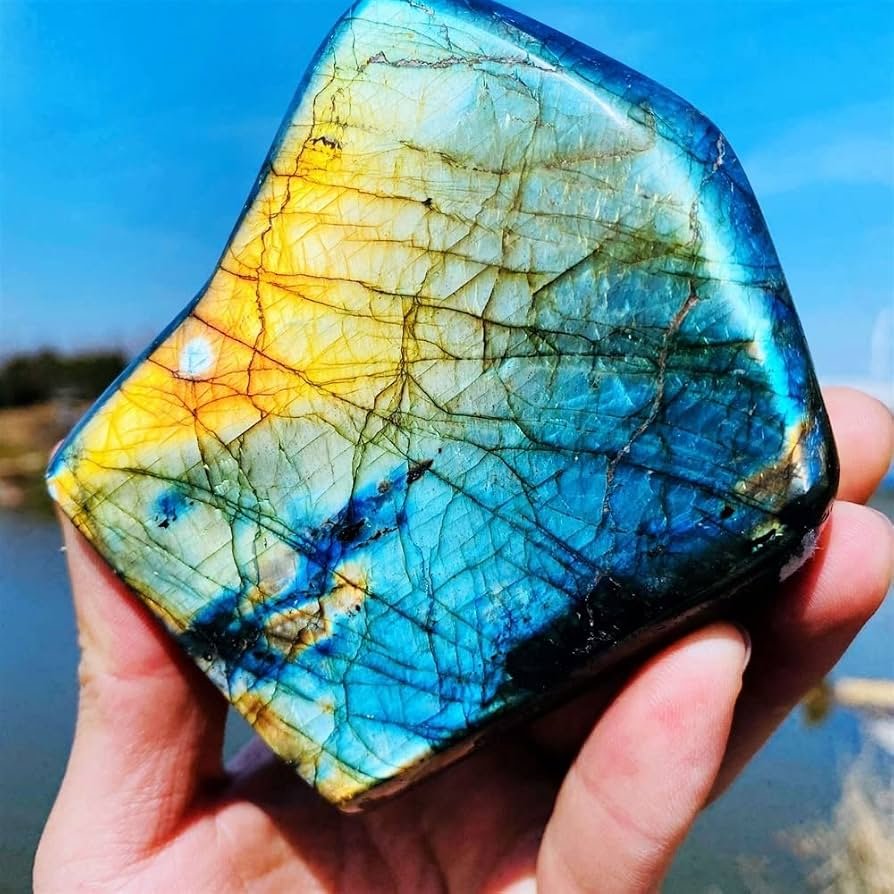
The most recognizable feature of Labradorite is labradorescence. This optical phenomenon occurs because of microscopic structures within the mineral that interact with light. As light enters the stone and reflects between different layers or structures, it can produce colorful flashes.
Blue is one of the most popular colors seen in Labradorite, but the stone can also show green, yellow, orange, gold, and violet tones.
Because of its distinctive appearance, Labradorite is often considered one of the most visually interesting decorative gemstones.
Labradorite Stone Meaning
Labradorite has developed many symbolic meanings in different modern gemstone traditions. It is commonly associated with transformation, creativity, mystery, intuition, and personal growth.
The stone’s changing flashes of color have inspired people to connect Labradorite with the idea of transformation. Its appearance seems to change depending on the angle of light, making it a natural symbol of change and adaptability.
Some people also associate Labradorite with imagination and creativity. Artists, designers, writers, and other creative individuals may appreciate the stone because of its unusual appearance and connection to mystery and inspiration.
It is important to distinguish these symbolic traditions from scientific facts. There is no reliable scientific evidence that Labradorite provides supernatural powers or medical benefits. Its value as a gemstone comes from its natural beauty, mineral characteristics, rarity, craftsmanship, and cultural symbolism.
The History of Labradorite
Labradorite became known to European scientists in the late eighteenth century after specimens were reported from Labrador, Canada. The mineral was named after this region.
Indigenous peoples of the Labrador region had long known about the area’s unusual stones before European scientific descriptions. The discovery of Labradorite deposits helped introduce this colorful mineral to a wider international audience.
Over time, Labradorite became increasingly popular among mineral collectors and jewelry designers. Its remarkable flashes of color made it especially attractive for decorative objects and polished stones.
Later discoveries in Madagascar and other regions expanded the availability and variety of Labradorite. Some deposits produce stones with particularly strong blue, green, or multicolored labradorescence.
Today, Labradorite remains an important collector’s mineral and a popular material for gemstone jewelry.
Where Is Labradorite Found?
Labradorite occurs in different geological environments around the world. Some of the best-known sources include Canada, Madagascar, Finland, Norway, Russia, Australia, and parts of the United States.
Labrador, Canada
Labrador is historically important because the mineral was named after this region. Canadian Labradorite remains significant to mineral history and geology.
Madagascar
Madagascar is one of the most important modern sources of Labradorite used in the gemstone and decorative-stone market. Madagascar Labradorite can display impressive blue, green, gold, and multicolored flashes.
Finland
Finland is famous for a related variety known as spectrolite. Spectrolite can show a broad spectrum of colors and is particularly valued by collectors.
Norway
Norway has also produced Labradorite and related feldspar minerals. Norwegian material contributes to the geological importance of Labradorite in northern Europe.
Russia
Russia has deposits of feldspar minerals, including Labradorite, and specimens may be found in mineral collections.
The appearance and quality of Labradorite can vary considerably depending on its geological source.
Labradorite Colors
Labradorite is best known for its colorful flashes, but the base color of the stone is often much more subdued.
Common body colors include:
- Gray
- Dark gray
- Brownish gray
- Blackish gray
- Greenish gray
The flashes may include:
- Blue
- Green
- Yellow
- Gold
- Orange
- Violet
- Multicolored combinations
Blue Labradorite is particularly popular because the contrast between the dark body color and bright blue flash can be dramatic.
Multicolored Labradorite can be even more visually impressive because different areas of the same stone may display several colors.
What Is Labradorescence?
Labradorescence is the optical effect that makes Labradorite famous.
When light enters the stone, it can interact with internal structures created during the mineral’s formation. These structures can cause light to be reflected and separated in ways that produce colorful flashes.
The result is a gemstone that may look completely different when viewed from different directions.
This effect is not the same as simply having a colorful surface. The color appears to come from within the stone and changes as the viewing angle changes.
Labradorescence is one of the most important factors that makes Labradorite attractive to collectors and jewelry designers.
Labradorite Stone Properties
Labradorite has several physical properties that help identify it.
Mineral Group
Labradorite belongs to the plagioclase feldspar group.
Hardness
Labradorite generally has a Mohs hardness of approximately 6 to 6.5.
This means it is reasonably durable but softer than many popular gemstones such as sapphire.
Luster
Labradorite typically has a vitreous to pearly luster.
Transparency
The stone can range from transparent to translucent, although gem-quality Labradorite used for jewelry is commonly translucent to opaque.
Crystal System
Labradorite crystallizes in the triclinic crystal system.
Cleavage
Like other feldspar minerals, Labradorite has good cleavage. This means it can break relatively easily along certain internal planes.
Its cleavage is an important reason to avoid rough handling and strong impacts.
How Is Labradorite Formed?
Labradorite forms as an igneous mineral, particularly in certain types of rocks such as gabbro, basalt, anorthosite, and related geological environments.
Its formation occurs over geological periods when molten rock cools and minerals crystallize.
The internal structures responsible for labradorescence develop as the mineral forms and changes at microscopic levels.
The exact appearance of a Labradorite specimen depends on its chemical composition, geological environment, internal structure, and subsequent geological processes.
This is why Labradorite from different locations can have noticeably different colors and patterns.
Labradorite vs. Spectrolite
Labradorite and spectrolite are closely related materials, and the terms are sometimes used differently depending on the source.
Spectrolite is particularly associated with Finland and is known for strong multicolored flashes.
Labradorite can also display multiple colors, but commercial Labradorite is frequently associated with material from Madagascar and other locations.
Both are attractive feldspar materials, but collectors may distinguish them based on geological origin and appearance.
Labradorite Jewelry
Labradorite is widely used in jewelry because its flashes create an eye-catching appearance.
Common Labradorite jewelry includes:
- Rings
- Necklaces
- Pendants
- Earrings
- Bracelets
- Brooches
- Statement jewelry
- Beaded jewelry
Labradorite is often cut as a cabochon rather than faceted. A smooth, curved cabochon surface can help reveal the stone’s labradorescence.
Labradorite Rings
Labradorite rings are popular among people who want unusual gemstone jewelry.
Because Labradorite has a hardness of around 6 to 6.5 and has good cleavage, rings should be worn with reasonable care. Rings are exposed to more impacts than pendants or earrings, so protective settings can be helpful.
A Labradorite ring can feature a simple polished stone or a larger statement cabochon surrounded by metal.
Silver-colored metals can create a modern contrast with the stone’s dark body color, while gold-colored metals can emphasize warm flashes.
Labradorite Necklaces and Pendants
Pendants are one of the most practical ways to wear Labradorite.
A pendant is generally less exposed to impacts than a ring, making it a suitable choice for people who want to display a larger Labradorite cabochon.
Large Labradorite pendants can showcase broad areas of blue, green, or multicolored labradorescence.
Labradorite Earrings
Labradorite earrings can range from small polished stones to larger statement designs.
Because earrings generally experience less physical contact than rings, Labradorite can work well in this type of jewelry.
Blue-flash Labradorite earrings are particularly attractive because the color can become visible when the stone moves under changing light.
Labradorite Bracelets
Labradorite beads are commonly used in bracelets.
Beaded bracelets can contain polished round stones or irregular natural pieces. Since bracelets can experience frequent contact with surfaces, it is important to avoid hitting Labradorite against hard objects.
Labradorite Cabochons
Cabochon cutting is especially popular for Labradorite.
Instead of creating multiple flat facets, a cabochon has a smooth, curved surface. This type of cutting can help display the stone’s internal flashes and patterns.
The quality of a Labradorite cabochon depends on factors such as color intensity, coverage, pattern, polish, shape, and overall appearance.
Labradorite Stone Benefits: Symbolic and Traditional Beliefs
Labradorite is associated with various symbolic benefits in modern crystal and gemstone traditions.
Commonly attributed symbolic qualities include:
- Transformation
- Creativity
- Inspiration
- Intuition
- Self-reflection
- Confidence
- Protection
- Personal growth
- Adaptability
These are cultural and spiritual beliefs rather than scientifically established effects.
People may enjoy Labradorite because its appearance provides personal meaning or inspiration. However, it should not be considered a substitute for professional medical, psychological, or other expert care.
Labradorite and Creativity
One of the most common symbolic associations with Labradorite is creativity.
Its constantly changing flashes can inspire artists and designers. A single stone can reveal different colors depending on lighting and viewing angle, making it an interesting natural example of visual transformation.
Creative people may use Labradorite as a decorative object, jewelry piece, or personal symbol of imagination.
Labradorite and Transformation
The changing appearance of Labradorite has made transformation one of its most popular symbolic themes.
From one angle, a stone may appear gray and simple. From another angle, bright blue or green flashes can suddenly appear.
This visual characteristic naturally encourages associations with change, discovery, and seeing things from different perspectives.
Labradorite and Intuition
In crystal traditions, Labradorite is sometimes associated with intuition and inner awareness.
These ideas are symbolic rather than scientifically proven. Nevertheless, some people use Labradorite as a reminder to slow down, reflect, and pay attention to their thoughts.
As a decorative stone, it can serve as a personal symbol of reflection without requiring any supernatural interpretation.
Labradorite and Meditation
Some people include Labradorite in meditation or mindfulness routines because they enjoy its appearance and symbolism.
A polished stone can be held or placed nearby while someone focuses on breathing, reflection, or relaxation.
The benefits of meditation and mindfulness come from the practice itself rather than from scientifically proven supernatural properties of Labradorite.
Is Labradorite a Birthstone?
Labradorite is not one of the official traditional birthstones recognized for the major Western birthstone calendar.
However, some modern jewelry and crystal communities associate Labradorite with certain birth months or astrological traditions.
These associations vary by source and should be understood as modern traditions rather than universal gemstone standards.
Labradorite and Zodiac Associations
Some modern crystal traditions associate Labradorite with zodiac signs such as Leo, Scorpio, Sagittarius, and Aquarius.
However, zodiac gemstone associations are not standardized. Different traditions may recommend different stones for the same zodiac sign.
Therefore, Labradorite can be enjoyed by anyone who appreciates its beauty, regardless of birth month or zodiac sign.
How to Choose a Good Labradorite Stone
When buying Labradorite, there are several characteristics to consider.
1. Color Flash
Strong, bright flashes are usually highly desirable.
Blue is extremely popular, but green, gold, orange, violet, and multicolored flashes can also be beautiful.
2. Flash Coverage
A stone with color covering a larger portion of its visible surface may be more attractive than one with only a small flash.
3. Pattern
Interesting natural patterns can increase the visual appeal of Labradorite.
4. Surface Quality
A good polish can make the stone’s labradorescence easier to see.
5. Shape and Cut
Cabochons should have smooth surfaces and proportions that allow the optical effect to be displayed effectively.
6. Cracks and Damage
Inspect the stone for major fractures, chips, or damage, especially when buying jewelry.
Labradorite Quality Factors
Unlike diamonds, Labradorite does not have one universal grading system.
Collectors and buyers often evaluate it based on:
- Strength of labradorescence
- Color
- Coverage of flash
- Pattern
- Clarity
- Polish
- Size
- Shape
- Origin
- Overall visual appeal
A smaller stone with exceptional color can sometimes be more desirable than a much larger stone with weak labradorescence.
How Much Is Labradorite Worth?
The price of Labradorite can vary significantly.
Factors influencing its price include:
- Size
- Quality
- Color
- Flash intensity
- Flash coverage
- Origin
- Cutting quality
- Craftsmanship
- Jewelry setting
- Rarity
- Market demand
Common commercial Labradorite can be relatively affordable, while exceptional specimens with intense multicolored labradorescence may command much higher prices.
It is important to compare several sellers and inspect the actual stone rather than judging value solely from photographs.
Is Labradorite Rare?
Labradorite itself is not among the rarest minerals in the world. However, high-quality material with exceptional labradorescence can be much less common.
The difference between ordinary Labradorite and a spectacular collector-quality specimen can be significant.
Strong blue flashes, broad color coverage, attractive patterns, and excellent polish can make particular specimens especially desirable.
Labradorite vs. Moonstone
Labradorite and moonstone are both feldspar minerals and can display attractive optical effects, but they look different.
Moonstone is famous for adularescence, which often appears as a soft, floating glow.
Labradorite is famous for labradorescence, which typically produces stronger flashes of blue, green, gold, or other colors.
Both can be beautiful, but their optical appearances are distinct.
Labradorite vs. Obsidian
Labradorite and obsidian can both have dark appearances, but they are completely different materials.
Labradorite is a crystalline feldspar mineral.
Obsidian is volcanic glass formed when lava cools rapidly.
Labradorite is recognized by its colorful internal flashes, while obsidian generally has a glassy appearance and can occur in several varieties.
Labradorite vs. Amethyst
Amethyst is a purple variety of quartz, while Labradorite belongs to the feldspar group.
Amethyst is generally recognized by its purple color, whereas Labradorite is recognized by its gray base and colorful labradorescence.
Their hardness is also different, with amethyst being harder than Labradorite.
Labradorite vs. Lapis Lazuli
Lapis lazuli is famous for its rich blue color and may contain golden pyrite inclusions.
Labradorite typically has a darker gray base with flashes of blue, green, gold, or other colors.
The two stones can both be used in jewelry, but their appearance and mineral composition are very different.
How to Clean Labradorite
Labradorite should be cleaned gently.
The safest general method is:
- Use lukewarm water.
- Add a small amount of mild soap if necessary.
- Gently wipe the stone with a soft cloth.
- Rinse carefully.
- Dry with a soft cloth.
Avoid harsh chemicals, abrasive cleaners, and rough brushes.
Because Labradorite has cleavage, strong impact and careless handling should also be avoided.
How to Care for Labradorite Jewelry
Proper care can help Labradorite jewelry remain attractive for many years.
Keep Labradorite away from:
- Harsh chemicals
- Abrasive cleaners
- Strong impacts
- Rough storage
- Extreme temperature changes
- Harder gemstones that may scratch it
When storing Labradorite jewelry, placing each piece in a soft pouch or separate compartment can reduce the chance of scratches.
Can Labradorite Go in Water?
Brief exposure to ordinary water during gentle cleaning is generally fine, but there is little reason to expose Labradorite to water for long periods.
For jewelry care, gentle cleaning with water and mild soap is preferable to soaking the stone unnecessarily.
Avoid using harsh cleaning solutions or unknown chemical treatments.
Can Labradorite Be Worn Every Day?
Labradorite can be worn regularly, but it is not as resistant to scratching and impact as harder gemstones such as sapphire.
For everyday use, pendants and earrings may be safer choices than rings because they are less likely to hit hard surfaces.
If wearing a Labradorite ring every day, extra care should be taken to protect it from impacts.
Labradorite for Home Decoration
Large Labradorite specimens are popular decorative objects.
Polished slabs can be displayed on shelves, desks, tables, and cabinets. When positioned near natural or artificial light, their flashes may become especially noticeable.
Large Labradorite pieces can also become conversation pieces because their colors change dramatically from different viewing angles.
Labradorite in Interior Design
Labradorite can add a natural and artistic element to interior spaces.
Decorators may use polished Labradorite slabs for:
- Table displays
- Shelving
- Decorative bowls
- Bookends
- Sculptures
- Accent pieces
The stone’s dark base and colorful flashes can work well with both modern and traditional interiors.
Labradorite for Collectors
Mineral collectors appreciate Labradorite because individual specimens can vary significantly.
Collectors may look for:
- Strong labradorescence
- Unusual colors
- Large specimens
- Excellent crystal formations
- Interesting geological origins
- Rare varieties
- High-quality polished slabs
A collector’s specimen does not necessarily need to be suitable for jewelry. Natural mineral specimens can have their own value and scientific interest.
Labradorite Slabs
Large Labradorite slabs can reveal patterns and color flashes that are difficult to see in small stones.
They are often polished to create smooth surfaces that make the labradorescence easier to observe.
High-quality slabs can be used for decorative purposes, furniture accents, display pieces, and interior design projects.
Labradorite in Modern Jewelry Design
Modern jewelry designers often use Labradorite because it offers something different from traditional transparent gemstones.
A Labradorite cabochon can become the central feature of a necklace or ring.
Designers may pair it with:
- Sterling silver
- Gold
- Gold-filled metal
- Other gemstones
- Beads
- Handmade settings
Its neutral gray base allows both cool and warm flashes to stand out.
Is Labradorite a Good Gift?
Labradorite can be an excellent gift for someone who enjoys gemstones, jewelry, minerals, or natural objects.
It can be especially meaningful as a symbolic gift connected with:
- New beginnings
- Creativity
- Personal growth
- Change
- Inspiration
A Labradorite pendant, polished stone, or small mineral specimen can be a thoughtful gift because each piece has its own natural pattern.
Labradorite Gift Ideas
Some popular Labradorite gift options include:
- Labradorite pendant
- Labradorite ring
- Labradorite earrings
- Labradorite bracelet
- Polished Labradorite palm stone
- Labradorite mineral specimen
- Labradorite cabochon
- Decorative Labradorite slab
- Labradorite bead set
- Labradorite display piece
The best option depends on whether the recipient prefers jewelry, collecting, decoration, or simply appreciating natural stones.
How to Tell if Labradorite Is Real
Identifying a gemstone with certainty can sometimes require professional testing.
However, genuine Labradorite commonly has:
- A feldspar-like appearance
- A gray to dark body color
- Distinctive labradorescence
- Natural internal patterns
- Hardness consistent with feldspar
- Typical cleavage characteristics
Very inexpensive stones marketed as Labradorite should still be purchased carefully, especially when strong claims are made about rarity or extraordinary powers.
For expensive specimens, professional gemological identification is a sensible choice.
Common Labradorite Treatments
Most Labradorite is valued in its natural form, although stones can be polished and shaped for jewelry and decorative use.
Buyers should ask sellers whether a gemstone has received any treatments, especially when purchasing expensive pieces.
A reputable seller should be able to explain the stone’s origin, treatment status, and quality.
Labradorite Mining and Sustainability
Like other natural stones, Labradorite is extracted from geological deposits.
Responsible sourcing is important because mining can affect landscapes, ecosystems, workers, and local communities.
Consumers interested in ethical gemstones can ask sellers about:
- Country of origin
- Mining practices
- Supplier transparency
- Labor conditions
- Environmental practices
Choosing reputable sellers can help encourage more responsible gemstone supply chains.
Why Is Labradorite So Popular?
Labradorite’s popularity comes largely from its unique appearance.
Many gemstones have recognizable colors, but Labradorite can appear to change color as it moves.
This creates a sense of depth and mystery that is difficult to reproduce naturally.
Its relatively accessible price compared with some high-end gemstones also makes it attractive to jewelry buyers and collectors.
Interesting Facts About Labradorite
Here are some interesting facts about Labradorite:
- Labradorite belongs to the feldspar mineral group.
- It was named after Labrador, Canada.
- Its famous optical effect is called labradorescence.
- Blue flashes are among the most popular.
- Labradorite can also show green, yellow, gold, orange, and violet.
- Madagascar is an important source of commercial Labradorite.
- Labradorite is commonly cut as a cabochon.
- It has a Mohs hardness of about 6 to 6.5.
- It has good cleavage.
- Labradorite can be used in jewelry and decorative objects.
- Finland is associated with a colorful variety known as spectrolite.
- Individual stones can have very different patterns.
- Its colors become visible under suitable lighting and viewing angles.
- Large Labradorite slabs can be used as decorative pieces.
- Labradorite is popular among mineral collectors.
Labradorite in Popular Culture and Modern Spirituality
Labradorite has become particularly popular in modern crystal culture.
Its unusual flashes and mysterious appearance have contributed to associations with transformation, intuition, creativity, and spiritual exploration.
Social media, handmade jewelry markets, interior design, and gemstone communities have also helped increase interest in Labradorite.
However, spiritual claims should be separated from scientifically established mineral properties.
The stone’s real geological characteristics are already fascinating without requiring supernatural explanations.
How to Display Labradorite
To display Labradorite effectively, lighting is important.
Try placing the stone where light can reach it from different angles.
Natural daylight can reveal blue, green, and gold flashes particularly well.
A rotating display stand can also make it easier to observe how the color changes as the viewing angle changes.
For large polished slabs, indirect lighting can highlight the internal patterns without creating excessive glare.
Labradorite for Beginners
If you are new to gemstones, Labradorite is a good stone to learn about because its appearance demonstrates how mineral structure can influence optical effects.
Start by examining a small polished cabochon or palm stone.
Move it slowly under a light source and observe how the colors appear and disappear.
This simple experiment demonstrates the basic idea behind labradorescence.
Buying Labradorite Online
When purchasing Labradorite online, product photographs can sometimes be misleading because lighting and camera settings can influence the appearance of the stone.
Before buying, consider checking:
- Actual product photographs
- Video under natural lighting
- Dimensions
- Weight
- Origin
- Treatment information
- Return policy
- Seller reputation
For expensive pieces, ask whether the photographs show the exact stone you will receive.
Labradorite SEO Keywords
If you are creating content around Labradorite stone, useful related keywords include:
- Labradorite stone
- Labradorite gemstone
- Labradorite meaning
- Labradorite properties
- Labradorite benefits
- Labradorite jewelry
- Labradorite stone benefits
- Labradorite crystal
- Labradorite stone price
- Labradorite meaning and properties
- Labradorite healing stone
- Blue Labradorite
- Madagascar Labradorite
- Labradorite cabochon
- Labradorite pendant
- Labradorite ring
- Labradorite colors
- What is Labradorite
- Labradorite stone care
- Labradorite gemstone meaning
These keywords can be naturally included in headings, paragraphs, image alt text, FAQs, and metadata without excessive keyword repetition.
Frequently Asked Questions About Labradorite
What is Labradorite stone?
Labradorite is a feldspar mineral known for its attractive flashes of blue, green, gold, yellow, and other colors. Its distinctive optical effect is called labradorescence.
What is Labradorite used for?
Labradorite is used for jewelry, cabochons, mineral specimens, decorative objects, polished slabs, carvings, and interior decoration.
What color is Labradorite?
The body of Labradorite is commonly gray or dark gray, while its optical flashes can appear blue, green, yellow, gold, orange, violet, or multicolored.
Is Labradorite expensive?
Labradorite can be relatively affordable, but high-quality stones with strong and widespread labradorescence can be significantly more valuable.
Is Labradorite a real gemstone?
Yes. Labradorite is a natural mineral that is widely used as a gemstone and ornamental material.
What makes Labradorite special?
Its labradorescence makes Labradorite special. The stone can display brilliant flashes of color that change as the viewing angle changes.
Can Labradorite be worn every day?
It can be worn regularly with care, but its hardness and cleavage make it more vulnerable to scratches and impact than harder gemstones.
How should Labradorite be cleaned?
Use lukewarm water, mild soap if necessary, and a soft cloth. Avoid harsh chemicals and abrasive cleaning methods.
Is Labradorite a birthstone?
Labradorite is not one of the traditional major Western birthstones, although some modern gemstone traditions associate it with particular months.
Where does Labradorite come from?
Important sources include Canada, Madagascar, Finland, Norway, Russia, Australia, and the United States.
Why does Labradorite change color?
The apparent color changes are caused by labradorescence, an optical effect produced by the interaction of light with internal structures in the mineral.
Is Labradorite good for jewelry?
Yes. Labradorite is commonly used in rings, necklaces, pendants, earrings, and bracelets, especially when cut as a cabochon.
Does Labradorite have healing powers?
Some crystal traditions attribute various healing or spiritual qualities to Labradorite, but these claims have not been established by scientific evidence. It should not replace professional medical care.
Final Thoughts on Labradorite Stone
Labradorite is a remarkable natural gemstone that combines geological science with extraordinary visual beauty. Its dark body color and brilliant flashes of blue, green, gold, yellow, and other shades make it one of the most distinctive members of the feldspar family.
The stone’s most famous feature, labradorescence, creates an appearance that changes as the stone moves under light. This optical phenomenon is the main reason Labradorite has become so popular among jewelry designers, mineral collectors, gemstone enthusiasts, and people who simply appreciate unusual natural materials.
From Labrador in Canada to Madagascar and other important deposits around the world, Labradorite has a fascinating geological story. It can be shaped into beautiful cabochons, incorporated into rings and pendants, polished into decorative slabs, or preserved as a natural mineral specimen.
For buyers, the most important considerations are color flash, coverage, pattern, polish, size, craftsmanship, and overall quality. Proper care is also important because Labradorite is not as hard as gemstones such as sapphire and has good cleavage.
Whether you are interested in Labradorite for jewelry, collecting, interior decoration, geology, or its traditional symbolism, this gemstone offers plenty to explore.
Ultimately, the appeal of Labradorite comes from its natural individuality. No two stones necessarily display exactly the same combination of patterns and flashes. That uniqueness is what makes Labradorite more than just another gemstone—it is a fascinating example of how minerals can interact with light to create extraordinary natural beauty.